AAM

Electrical engineering · Machine learning · Energy systems

Abdullah / Al Mahmood

Research engineer working on machine learning for energy systems, air quality and transport behaviour. Six and a half years in applied engineering, four of them in a dedicated research role. Seeking a funded doctoral position.

Applied engineering

6.5

years

4 years in a dedicated research role

Peer-reviewed output

4

papers

+1 in preparation · 2 theses

MSc ICT · CGPA

3.81

/ 4.00

Earned in full-time employment

One question, carried

14

years

2012 thesis → ML extension today

  • #MachineLearning
  • #EnergySystems
  • #AirQuality
  • #RoadSafety
  • #ExplainableAI
  • #SouthAndSoutheastAsia
Scroll

Profile

Engineering training, environmental data and measured behaviour, pointed at one question.

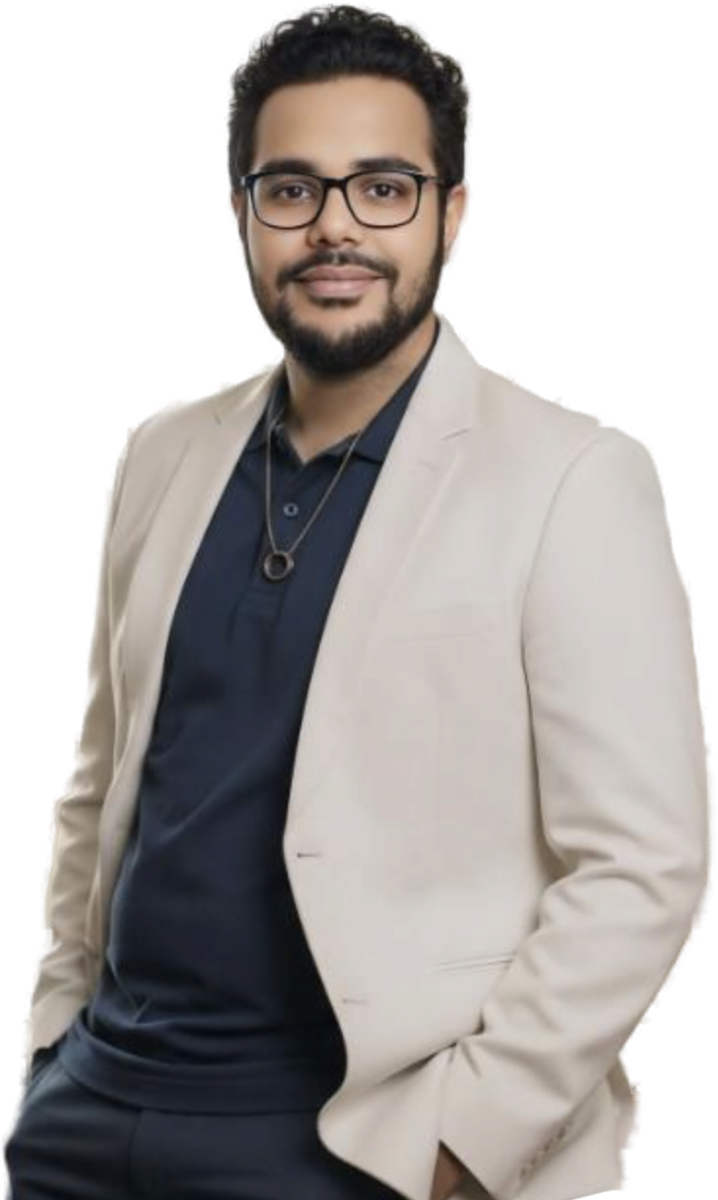
Portrait of Abdullah Al Mahmood

I am an electrical and electronic engineer with six and a half years in applied engineering, four of them in a dedicated research engineering role, and an MSc in Information and Communication Technology completed alongside full-time work at Bangladesh University of Professionals.

My published work covers applied machine learning on environmental and public-health data, model interpretability, and health technology adoption. My longest-running line of work runs from my 2012 undergraduate thesis to its machine-learning extension today, and asks a single question: how should a supply-constrained national grid be scheduled so that load shedding falls?

Since 2019 I have also operated large-scale algorithmic advertising systems. That is not a detour. It is sustained practice in controlled testing at population scale, and a view of automated decision-making from inside the system rather than from the outside.

Doctoral directions

Four questions, one method: measure what people and systems actually do, not what they say they will do.

Each direction below is already load-bearing somewhere in my record — a thesis, a paper, or four years of operating the systems in question. I am open to a supervisor reshaping any of them.

01 / transport

Driver behaviour and road safety under vehicle electrification

Does switching vehicle type change how the same individual drives? My MSc thesis built deep-learning detection of over-speeding and lane changes from naturalistic footage of mixed, weakly regulated urban traffic — a setting almost absent from a literature trained on regulated European and North American roads.

02 / energy

Energy transition governance under scarcity in South and Southeast Asia

Including the comparison between rationing by outage and rationing by connection restriction. This is the decade-long thread: from peak-shaving hydro dispatch in my BSc thesis to learned dispatch policies under chronic generation shortfall today.

03 / infrastructure

The energy, water and material footprint of AI infrastructure

With particular attention to tropical siting and the Johor–Singapore cluster. It joins my grid-side training to the environmental modelling in my 2026 conference work, and sits on my doorstep.

04 / behaviour

Stated intention versus observed behaviour, and automated persuasion

For high-cost, infrequent purchases such as vehicles — and, relatedly, how optimisation systems reach targeting decisions, and where regulatory assumptions diverge from operational reality. I have run these systems daily since 2019.

Methods I bring

Supervised machine learning, model benchmarking and validation · explainable AI (LIME, SHAP, feature importance) · deep learning for computer vision · experimental design and controlled A/B testing at population scale · survey design · in-depth interviewing and thematic analysis · research ethics procedure and institutional approval · Python, including deep-learning implementation.

Publications

Four peer-reviewed outputs, one in preparation, two theses.

ORCID 0009-0009-8360-9690. Author name in bold. Full texts on request.

  1. P1

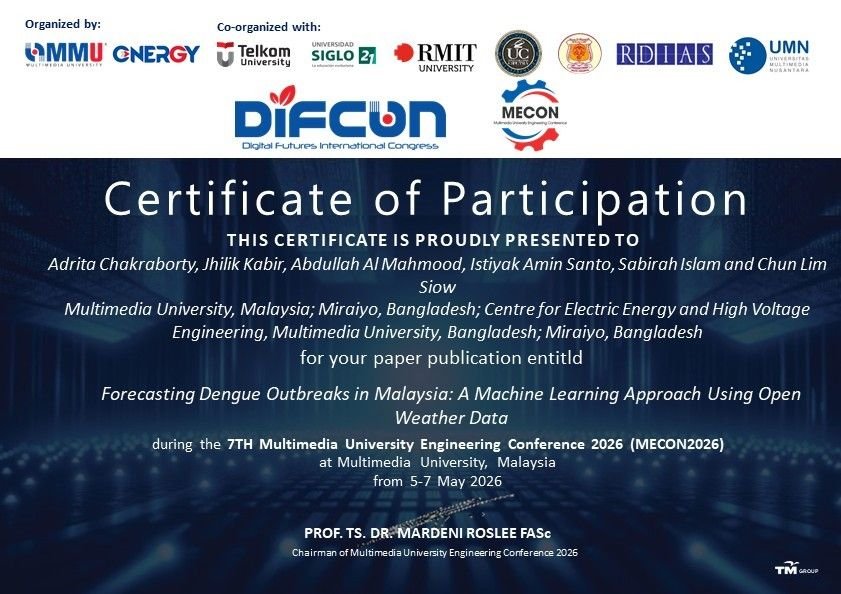
    Forecasting Dengue Outbreaks in Malaysia: A Machine Learning Approach Using Open Weather Data

    Adrita Chakraborty, Jhilik Kabir, Abdullah Al Mahmood, Istiyak Amin Santo, Sabirah Islam, Chun Lim Siow

    7th Multimedia University Engineering Conference (MECON2026 / DIFCon 2026), Multimedia University, Malaysia, 5–7 May 2026

    A predictive framework built on open-source meteorological data to forecast dengue outbreak trends across Malaysia, aimed at early warning and public-health preparedness. Affiliations: Multimedia University, Malaysia; Miraiyo, Bangladesh; Centre for Electric Energy and High Voltage Engineering.

    Conference 2026 Environmental ML
  2. P2

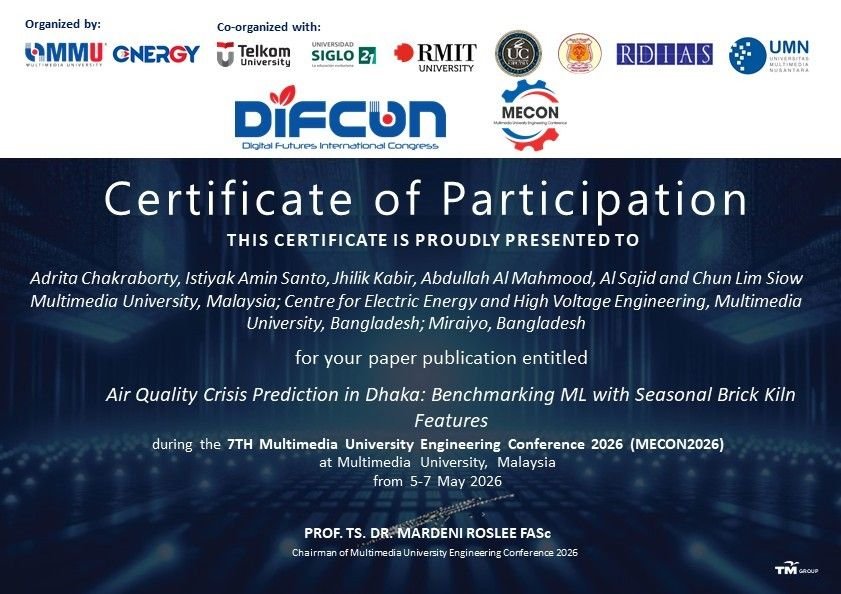
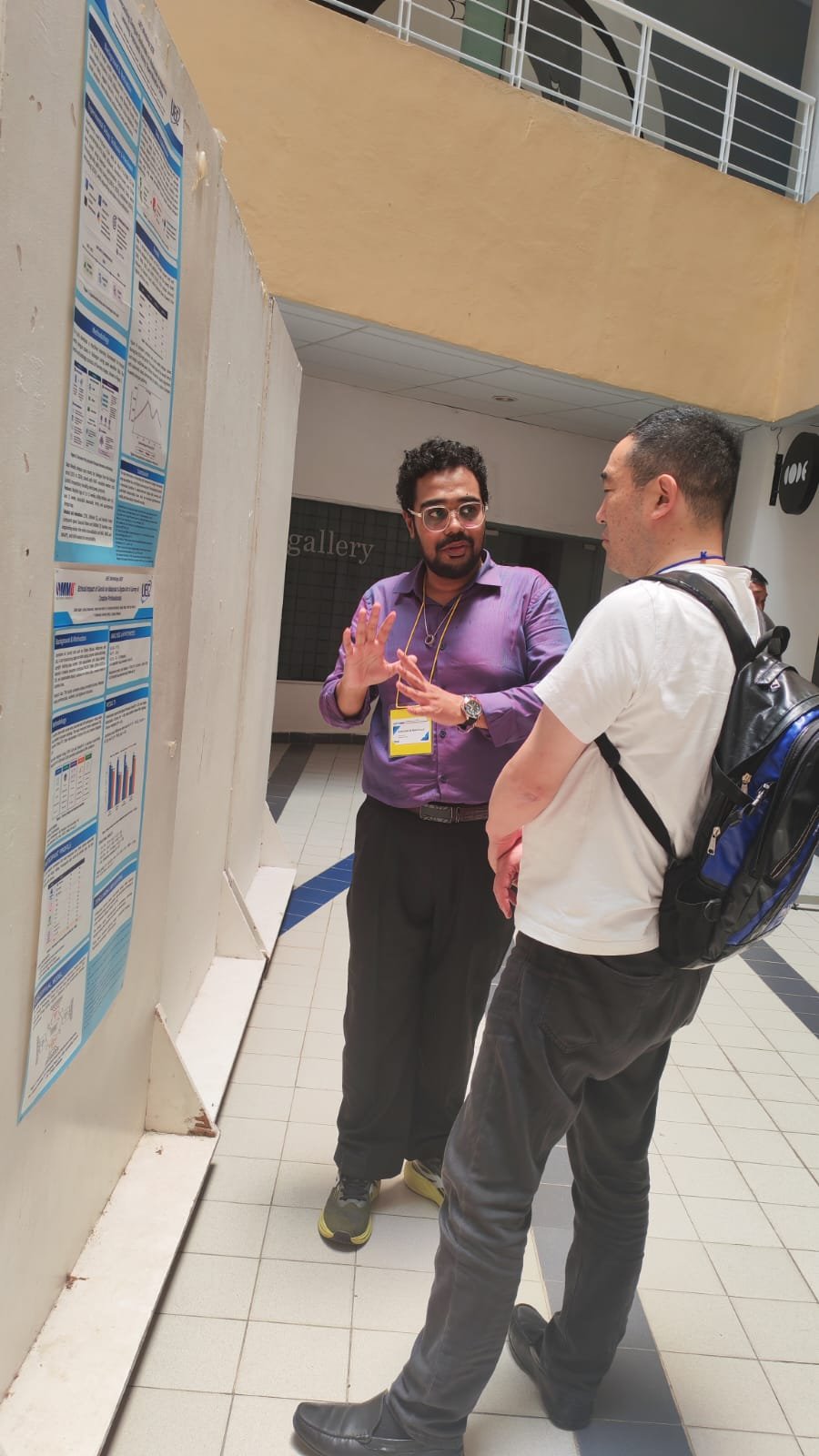
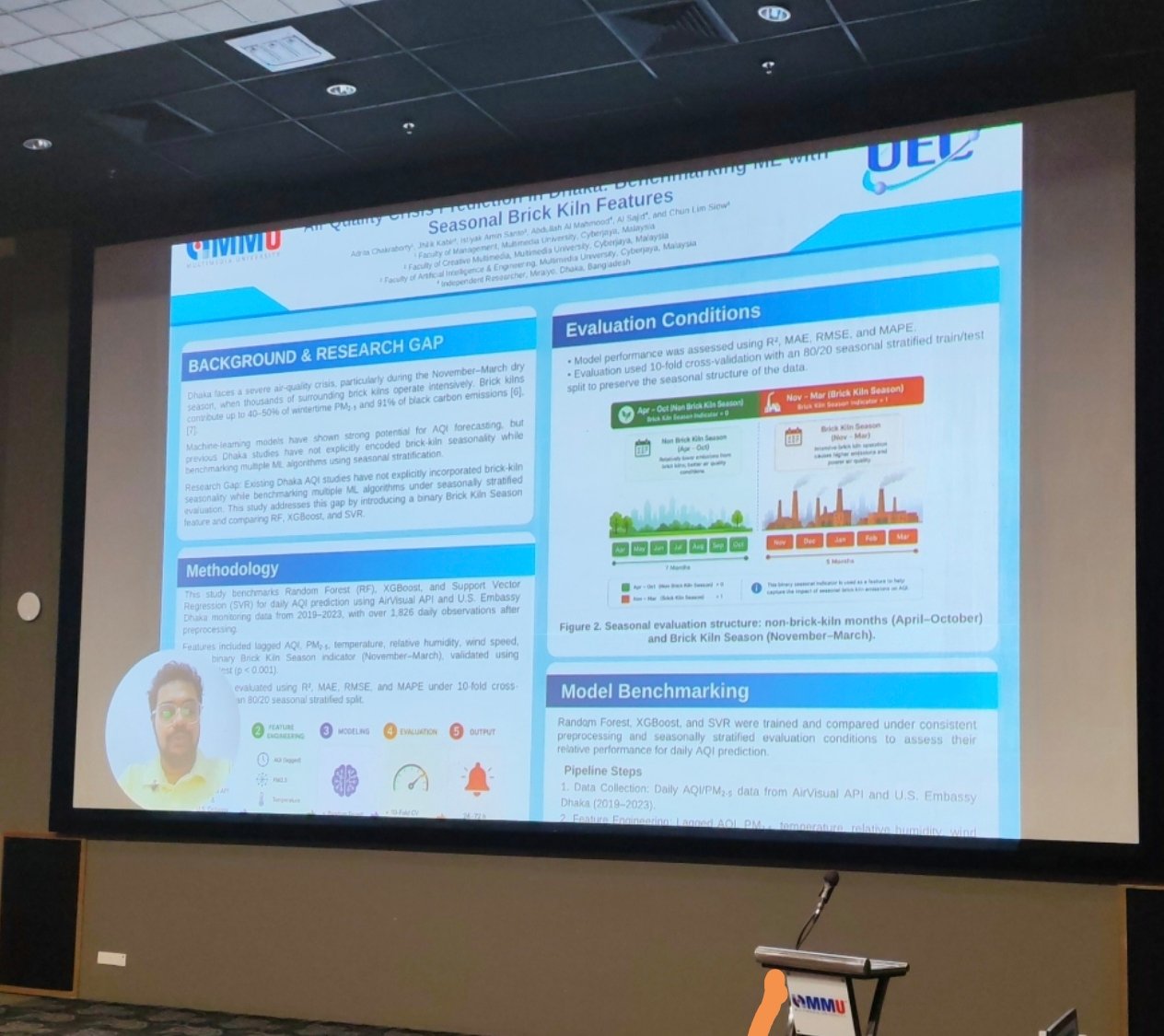
    Air Quality Crisis Prediction in Dhaka: Benchmarking Machine Learning with Seasonal Brick Kiln Features

    Adrita Chakraborty, Istiyak Amin Santo, Jhilik Kabir, Abdullah Al Mahmood, Al Sajid, Chun Lim Siow

    7th Multimedia University Engineering Conference (MECON2026 / DIFCon 2026), Multimedia University, Malaysia, 5–7 May 2026

    Benchmarks machine-learning algorithms against seasonal operational features of brick kilns to forecast severe air-quality degradation in Dhaka — a source term that generic pollution models routinely omit.

    Conference 2026 Environmental ML
  3. P3

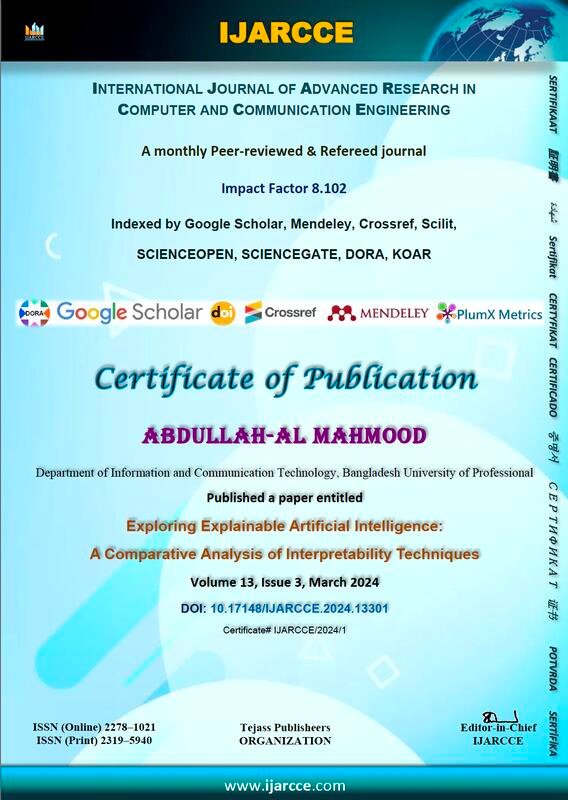
    Exploring Explainable Artificial Intelligence: A Comparative Analysis of Interpretability Techniques

    Jhilik Kabir, Adrita Chakraborty, Abdullah Al Mahmood, Aditi Chakraborty

    International Journal of Advanced Research in Computer and Communication Engineering (IJARCCE), March 2024

    Compares LIME, SHAP and conventional feature importance on a decision-tree classifier. Finds high local precision and recall for LIME, a local–global balance for SHAP, and sets out practical selection criteria for interpretability frameworks.

    Journal 2024 Read →
  4. P4

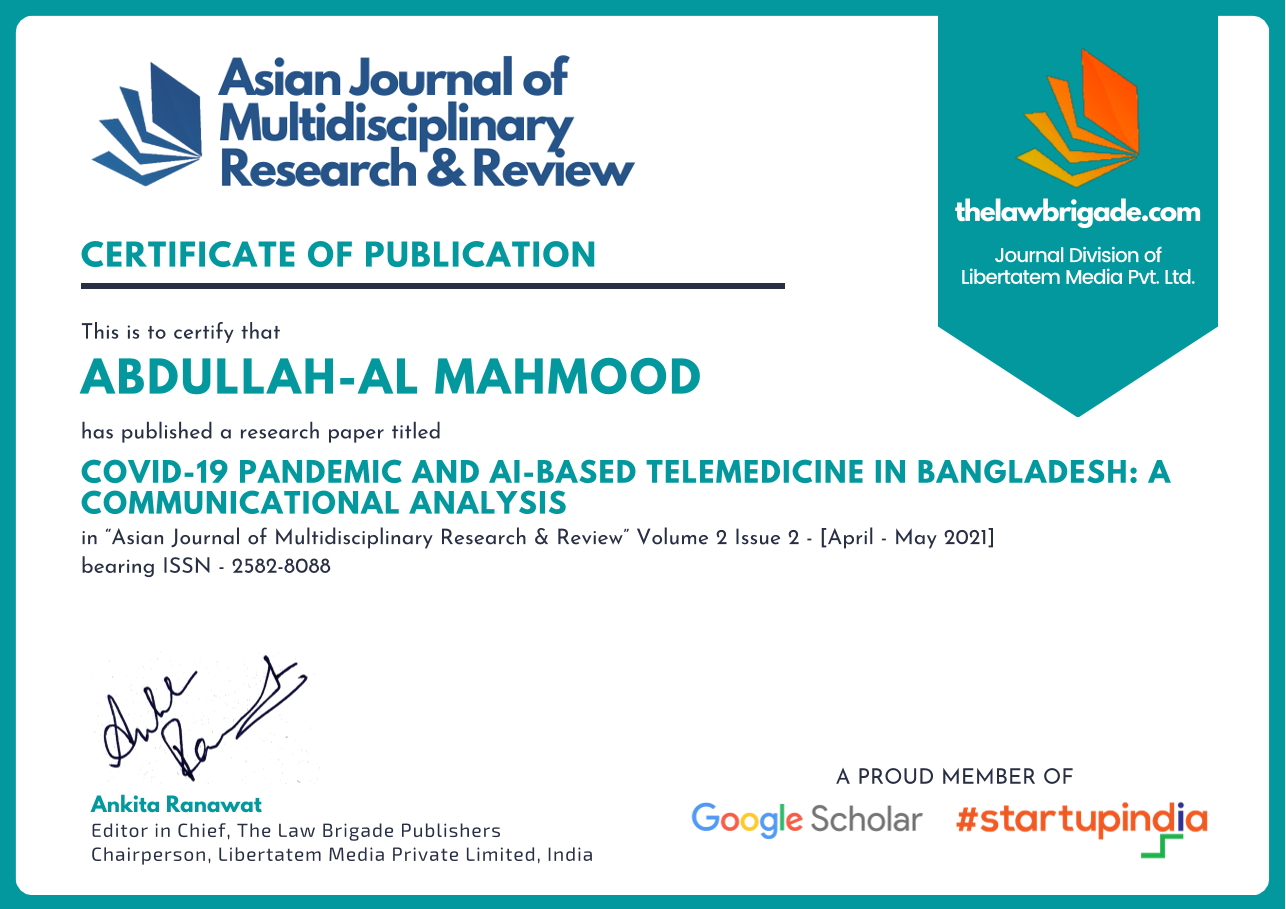
    COVID-19 Pandemic and AI-Based Telemedicine in Bangladesh: A Communicational Analysis

    Abdullah Al Mahmood (sole author)

    Asian Journal of Multidisciplinary Research & Review (AJMRR), 2(2), 592–621, 2021. ISSN 2582-8088

    Mixed-methods study of how AI-driven telemedicine was implemented and adopted in Bangladesh during the pandemic. Thirty-five in-depth interviews with practitioners, patients and platform staff; purposive sampling; instrument designed and all data collected by the author under institutional ethics approval.

    Journal 2021 Primary data
  5. P5

    Applying AI for Optimal Hydroelectric Power Management: A Strategy to Combat Severe Load Shedding in Bangladesh

    Abdullah Al Mahmood

    In preparation

    Replaces the rule-based peak-shaving schedules of my undergraduate thesis with learned dispatch policies under chronic generation shortfall. The same question, fourteen years on, with the methods that were not available the first time.

    In preparation
  6. T1

    Towards Deep Learning-Based Automated Speed and Lane Change Detection System in Perspective of Bangladesh

    Abdullah Al Mahmood and group — MSc thesis

    Bangladesh University of Professionals, Faculty of Science and Technology, Dhaka. Examined March 2022

    Deep-learning models applied to naturalistic traffic footage to detect over-speeding and lane-change manoeuvres in mixed, weakly regulated urban traffic — a setting under-represented in driver-behaviour research.

    MSc thesis
  7. T2

    Optimal Peak Shaving Operation of Hydroelectric Power Station in Bangladesh and its Impact on the Reduction of Severe Load Shedding

    Abdullah Al Mahmood — BSc thesis

    Ahsanullah University of Science and Technology, Dhaka, 2012

    Dispatch scheduling to flatten demand peaks in a chronically supply-constrained national grid. Extended a decade later with machine-learning methods — see P5.

    BSc thesis

Where I have been

Fourteen years between the first version of the question and this one.

Research and education

  1. 2025 — 2026

    Research collaboration — environmental and climate-health machine learning

    Multimedia University, Malaysia · Miraiyo, Bangladesh · Centre for Electric Energy and High Voltage Engineering. Supervising collaborator: Dr Siow Chun Lim. Output: P1 and P2.

  2. 2019 — 2022

    MSc, Information and Communication Technology — CGPA 3.81 / 4.00

    Bangladesh University of Professionals, Dhaka. Completed in full-time employment. Group thesis on deep-learning speed and lane-change detection.

  3. 2015 — 2019

    Research Engineer

    Debonair Electrical & Electronics Ltd., Dhaka. Four years of applied product research and technical evaluation, reported to international suppliers and industrial clients; trained junior engineers.

  4. 2008 — 2012

    BSc, Electrical and Electronic Engineering

    Ahsanullah University of Science and Technology, Dhaka. Thesis on peak-shaving hydro dispatch and load shedding.

Applied and industry

  1. 2024 — present

    Social Media & Content Manager, Paid Media

    Black Swan Business Setup Services, UAE (remote). Paid acquisition across five markets; builds and runs the full measurement stack (GA4, Tag Manager, Conversions API, Looker Studio). Population-scale controlled testing with measured outcomes.

  2. 2019 — 2024

    Technical Writer · Marketing Manager · Assistant Manager

    BuddyBoss, Canada · STUDiLOG · Enzaime Bangladesh. Developer documentation and pre-release testing; the Enzaime role provided the field access behind P4.

  3. 2013 — 2015

    Support Engineer

    Ahsan Automation Ltd., Dhaka. Industrial automation design and implementation; engineering drawing; collaboration with international manufacturers on new products.

Languages

Bengali — native, and a working research capability for fieldwork and document access in Bangladesh. English — full professional proficiency, medium of instruction throughout higher education. Working familiarity with Malay-language regional sources.

Contact

I am looking for a funded doctoral position starting 2027.

If any of the four directions above overlaps with your group’s work, I would value a short conversation. I can send a two-page research proposal, full texts of any paper listed here, and my transcripts on request.

I am a Bangladeshi national, currently resident in Malaysia, and available to relocate. My strongest independent evidence is publication P4 — a sole-authored, interview-based study run end to end under institutional ethics approval — and the fourteen-year thread from my undergraduate thesis to the dispatch work now in preparation.

The fastest way to reach me is email. I reply within a day.